

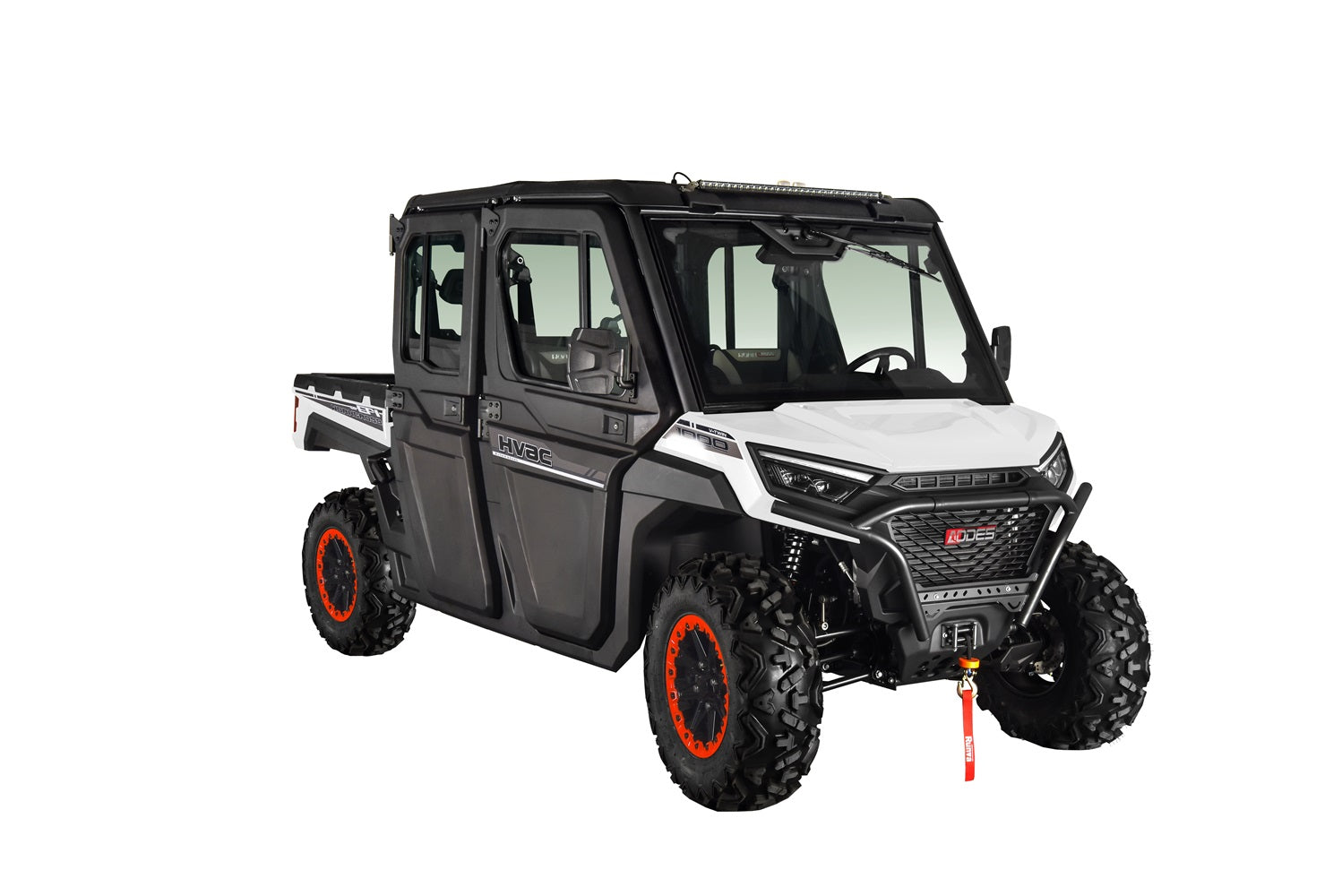
The core difference starts with design philosophy. Most commercial UTVs on the market today—even those marketed as “work” models—originate from recreational platforms. They are engineered first for speed, ride comfort, and broad consumer appeal, and then adapted for commercial use. The
WorkCross takes the opposite approach. It was designed from day one for heavy payloads, towing, continuous duty cycles, and harsh jobsite environments. That philosophy shows up in the physical structure of the machine. The WorkCross uses heavier-gauge steel throughout the chassis, reinforced structural components, and a higher overall curb weight that reflects real material strength rather than weight reduction shortcuts. Where others prioritize lighter weight and performance, the WorkCross prioritizes durability and longevity, because in commercial environments, weight is not the problem—failure is.
We see the consequences of that difference in the field every day. We are currently speaking with a power line company in Utah that told us they are cycling through Polaris commercial UTVs every 6 to 12 months. Their crews are hard on equipment, as most crews are in real-world conditions, and the machines simply don’t hold up to the sustained abuse. That is exactly why they began looking at alternatives like the AODES platform. When equipment becomes a consumable instead of an asset, the cost is not just in replacement—it is in downtime, lost productivity, and constant disruption to operations.
That design approach is not theoretical. It has now been proven in real-world conditions. We sold a WorkCross 1000-6 to a customer operating in mountainous terrain on the Hatfield and McCoys trail in West VA.. During a descent, the driver lost control coming down a mountain and hit some boulders so hard that it burst the two front. In most machines, that kind of impact could result in significant structural damage or total loss. In this case, the vehicle absorbed the force with only a minor crack in a single A-arm. We repaired the A-arm, and the structure of the vehicle remained intact. To support the customer, we ultimately bought the unit back and replaced it with a new one, but what happened next gave us even more insight into what this machine is capable of.
Back at our facility, one of our BDX team members made a poor decision and attempted to push the vehicle beyond reasonable limits trying to turn donuts with a 2400 pound machine, resulting in a rollover. What we found afterward was remarkable. The engine ran perfectly, the drivetrain was unaffected, and the frame maintained its integrity, the roors and outside of the vehicle received zero damage. The only damage was a broken windshield. There was no structural collapse, no major component failure, and no loss of functionality and no cosmetic damage. The vehicle simply kept working.

After two major accidents and some rough riding on the owners farm the vehicle still looks new. These were not controlled tests or ideal scenarios. They were real-world incidents that reflect how equipment is actually used in commercial environments. Fleet vehicles are operated by multiple users, pushed hard, loaded heavily, and used in unpredictable conditions. We expect abuse and the vehicle has been designed for abuse, And this is what BDX has done since its inception in 2006--read here. That is the reality of construction sites, data centers, utility companies, and energy infrastructure projects. The WorkCross was designed with that reality in mind, and these events demonstrate the outcome of that design philosophy.

No machine is truly indestructible, and physics always applies. However, the real question for any business is not whether a vehicle can be broken, but how much abuse it can take before it impacts operations. After surviving both a severe mountain impact and a full rollover, and continuing to run and perform, the WorkCross 1000-6 has demonstrated a level of durability that directly translates into reduced downtime, fewer repairs, and greater operational reliability.
We did not set out to prove that the WorkCross was nearly indestructible. The employees and customers did that for us. What we set out to build was a machine that could handle real work, real environments, and real-world abuse. The result is a vehicle that keeps going when others would likely fail—and in a commercial operation, that difference matters.
